
Connecting people is fundamental to modern societies, making the transport sector vital for both the economy and citizens’ well-being. To make that connection sustainable, environmental factors must be included in the equation. Nowadays, climate change dominates the environmental agenda, while biodiversity a fundamental components of sustainable solutions is often overlooked.
As the SYMBIOSIS project aims to place biodiversity onto the agenda of sustainable transport, a specific project task focuses on changing the scale of perspective. Europe, particularly its central regions, is among the most fragmented landscapes globally, as highlighted by the European Environment Agency (Figure 1). This means that the development of transport corridors must be balanced with the preservation of ecological networks.
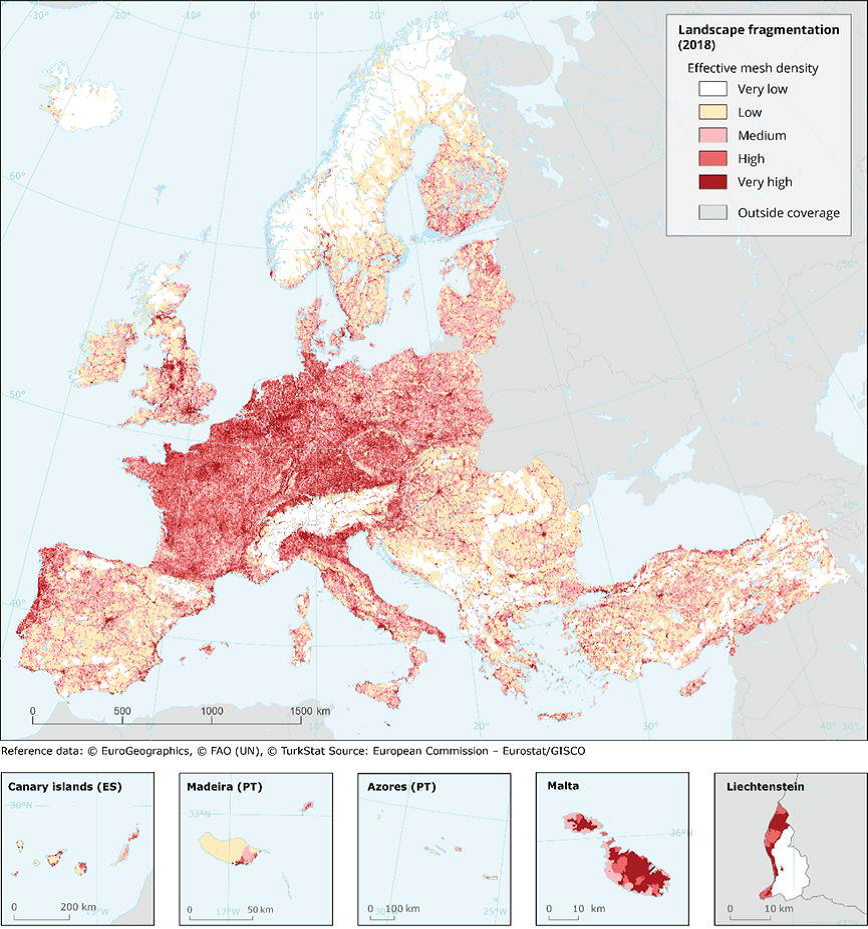 Figure 1: Effective mesh density — fragmentation status in Europe in 2018; Source: EEA, 2021
At the same time, from a strategic perspective, the EU aims to develop and establish two complementary networks: one for transport, known as the Trans-European Transport Network (TEN-T), guided by Regulation (EU) 2024/1679, and one for nature, known as the Trans-European Nature Network (TEN-N), derived from the EU Biodiversity Strategy. SYMBIOSIS emphasizes that these two networks must meet and coexist under the umbrella of the EU Green Deal.
One of the main objectives of the project is to address the need for a change in the scale of perspective when planning, developing, and maintaining transport infrastructure. Due to the demand for rapid development, environmental assessments typically focus on the impacts of a single linear transport infrastructure project. However, this approach is comparable to caring for a single tree without considering the forest. By changing the scale of perspective, SYMBIOSIS seeks to address the challenges associated with assessing the cumulative impacts of paired or bundled linear transport infrastructure, including energy transportation infrastructure as powerlines.
Desk-based literature reviews, stakeholder outreach and engagement to build a comprehensive dialogue, the organisation of dedicated events and conference sessions, and the distribution of a targeted questionnaire have been the main actions undertaken by SYMBIOSIS since the beginning of the project. Early results suggest indicate that the challenges can be grouped into four distinct categories:
- governance and stakeholder engagement challenges related to management, coordination, and participation;
- spatial and technical planning challenges related to infrastructure design, spatial configuration, and assessment methods;
- ecological and biological challenges related to understanding, measuring, and predicting ecological effects; and
- conceptual challenges concerning methodologies, underlying assumptions, analytical frameworks, and data limitations.
This task is ongoing. Stakeholders across Europe and beyond, representing diverse sectors and expertise, continue to provide feedback through the project questionnaire: https://docs.google.com/forms/d/e/1FAIpQLSfi-0MSIHDJkQt23mVen593nJ0rwUwZVGRio2PvjqhS6C2Sew/viewform?usp=sharing&ouid=101634565566237098820,
Stay tuned for upcoming updates and opportunities to get involved.