
26 November 2026
SYMBIOSIS WP4 November update: website article and ERJU news
Listening to the lineside: AI-assisted bird and bat monitoring on railway verges
SYMBIOSIS has tested a standardised, AI-assisted monitoring workflow on railway verges in the UK, Spain and Portugal, collecting more than 4,000 hours of bird recordings and 325 hours of bat ultrasound. The analysis of these recordings is now complete, and the approach is already attracting interest well beyond the project.
Railway verges: an overlooked habitat
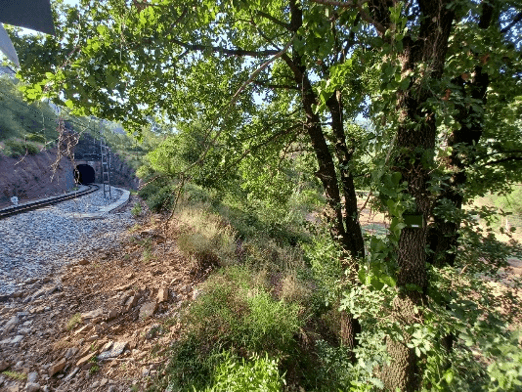
Europe's railway network spans over 200,000 km. Its verges form one of the largest continuous networks of semi-natural habitat on the continent, where birds and bats nest, roost and forage. Yet these verges are still managed mainly as engineering assets, and little data exists on the wildlife they support.
A summer of listening
Last summer, the SYMBIOSIS team tested a standardised monitoring workflow across nine sites in the UK, Spain and Portugal. Twenty-eight small automated passive acoustic recorders were fixed to fences and trees along the verges. Together, they captured more than 4,000 hours of bird sound and 325 hours of bat ultrasound.
AI to make sense of thousands of hours of sound
The recordings were processed with the latest AI classifiers: BirdNET for birds, and BatDetect2 and BSG for bats. The screening identified over 250 bird species and 20 bat species.
One field app to coordinate three countries
Each recorder deployment was logged in a standard ArcGIS field app, developed by Josep Serra Gallego, GIS expert at the UK Centre for Ecology & Hydrology (UKCEH). The app made it possible to coordinate and record deployments consistently across the three countries, and its results can be easily integrated with existing GIS asset data and management tools.
On 10 November 2026, Josep presented the platform at Esri UK's conference in Wales, together with his UKCEH colleague Claire Wood, in a session on how ArcGIS supports environmental and biodiversity monitoring. Although the conference mainly targeted the private sector, the work was very well received, and Josep has been invited to submit it to an Esri innovation Program. Programme of the session
Why it matters for rail
Consistent, cost-effective monitoring gives asset managers the evidence they need to target vegetation management, protect high-value habitats, meet reporting obligations and demonstrate nature-positive outcomes across the network. Stakeholders are already looking forward to the results: Wildlife Trusts in the UK are keen to see more of this work, and the Catalan railway operator is eager to discover what is singing and roosting next to its tracks.
Stay tuned for more results from SYMBIOSIS in the coming months.
ERJU newsletter news
SYMBIOSIS listens to the lineside: AI-assisted monitoring of birds and bats
Europe's railway network spans over 200,000 km, and its verges form one of the continent's largest continuous networks of semi-natural habitat. Birds and bats nest, roost and forage there, yet little data exists on this wildlife.
Last summer, SYMBIOSIS tested a standardised monitoring workflow at nine sites in the UK, Spain and Portugal. Twenty-eight automated passive acoustic recorders captured more than 4,000 hours of bird sound and 325 hours of bat ultrasound. Using recent AI classifiers (BirdNET, BatDetect2 and BSG), the team identified over 250 bird species and 20 bat species.
All deployments were logged in an ArcGIS field app developed by Josep Serra Gallego (UKCEH), so the results can feed directly into existing GIS asset data and management tools. Josep presented the platform at Esri UK's conference in Wales in November, where it was very well received, and has been invited to submit it to an Esri innovation contest.
For rail infrastructure managers, this kind of consistent and cost-effective monitoring provides the evidence needed to target vegetation management, protect high-value habitats, meet reporting obligations and demonstrate nature-positive outcomes. Wildlife Trusts in the UK and the Catalan railway operator are already looking forward to the results.